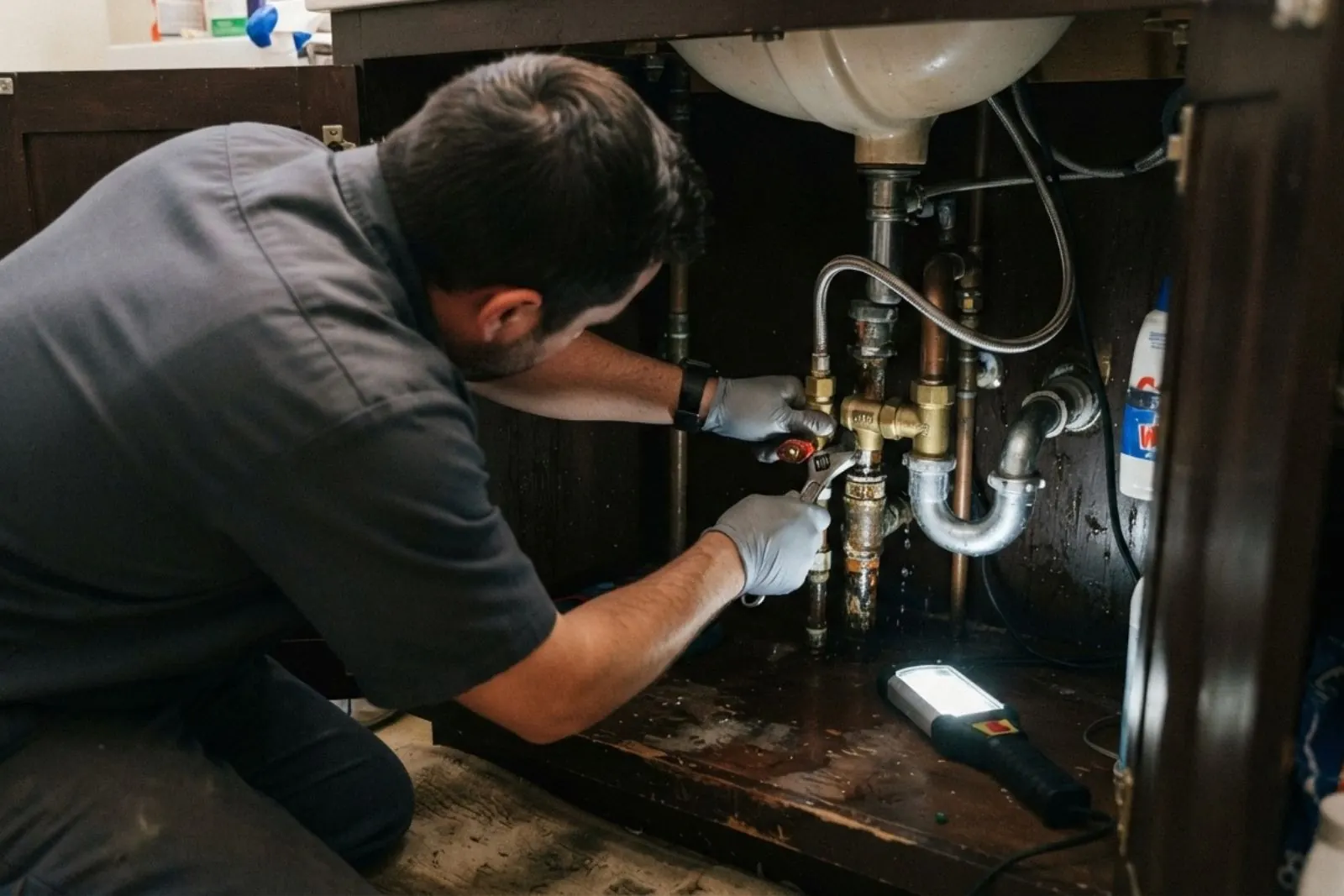
Plumbing repair for the parts that wear out first
General plumbing repair means fixing or replacing a single failed component so the rest of the system keeps working. It covers valves, supply lines, drain traps, fixture parts, and short sections of damaged pipe, as opposed to replacing a whole system.
Much of Surprise was built between the mid-1990s and 2010. At that age, the first parts to fail are small ones: the angle stop under a sink that no longer closes, a plastic supply line that has gone brittle, or a toilet fill valve that runs all night.
None of these are dramatic on day one. A running toilet can waste a large amount of water in a month, though, and a supply line that fails behind a vanity can flood a room in minutes. Fixing them early is almost always cheaper than waiting.
Plumbing emergency: what counts and what to do first
Not sure whether your problem is an emergency? If water is flowing that you cannot stop, sewage is coming up, there is no water at the house or water is coming through a ceiling, call now. Those are the situations the emergency line is for.
If it is a drip, a slow drain or a running toilet, you can book a regular visit. We will tell you which kind you have on the phone.
- 1Find the main shutoff.Know where it is before you need it. It is usually on the front wall or at the meter.
- 2Stop the water if you can.Close the valve for a single fixture, or the main for the house.
- 3Move valuables and electronics.Get them off the floor and away from the leak.
- 4Call the emergency line.The dispatcher asks what you see and sends a plumber.
Common repairs and what they involve
These are the jobs that make up most repair calls in Surprise homes.
| Part | What you notice | Typical fix |
|---|---|---|
| Angle stop valve | Handle will not turn, or it drips at the stem. | Replace with a new quarter-turn valve. |
| Braided or plastic supply line. | Bulging, rust at the nut, or a slow drip. | Swap for a new braided stainless line. |
| P-trap under a sink | Water in the cabinet, loose slip nut. | Reseat or replace the trap assembly. |
| Toilet fill valve or flapper. | Toilet refills on its own or runs nonstop. | Replace the worn part inside the tank. |
| Pressure reducing valve | Banging pipes, dripping relief valve, very strong flow. | Test pressure and replace the PRV if it has failed. |
| Short pipe section | A pinhole, crack, or failed fitting in an accessible spot. | Cut out the damaged section and splice in new pipe. |
Why water pressure deserves a check on every repair
Many Surprise homes have a pressure reducing valve near where the main line enters. When that valve fails, full street pressure reaches every faucet, toilet, and appliance hose in the house. The International Plumbing Code caps static pressure at 80 psi for that reason.
High pressure speeds up wear on every part in this list. A five-dollar gauge on a hose bib tells you where you stand, and a failed PRV explains why several parts seem to be breaking at once.
How the age of your home shapes the repair
Kingswood Parke homes went up mostly in the 1990s, and many Sun City Grand homes date from the late 1990s and early 2000s. In houses that age, original shutoff valves and supply lines are at or past their expected life. Replacing all the angle stops in a kitchen and two baths at once is often more sensible than calling back for each one.
Newer neighborhoods have a different pattern. Homes built after about 2005 more often have a loose fitting, a pressure issue, or a fixture that was never quite set right. The repair is usually small, but finding the actual cause keeps it from coming back.
If the repair turns out to be a hidden leak rather than a visible drip, leak detection locates it first so nothing is opened up on a guess.
Most repair parts here fight the same enemy: mineral scale from EPCOR and City of Surprise water, much of it pumped from West Valley groundwater in Maricopa County. Homes near Bell Road that are 25 years old often need several of those worn parts replaced at once.
What to do before something breaks: learn your shutoffs
Every repair call goes better when you already know how to stop the water.
- Fixture valves. Look under each sink and behind each toilet for a small valve. Turn it clockwise to close.
- Water heater cold inlet. The valve on the cold pipe above the heater isolates the tank without shutting off the house.
- House main. The house main usually sits close to the point the water line comes into the home, commonly on a garage wall or the side facing the street.
- Meter valve. If the house main will not close, the valve at the meter box stops water from the street. It may need a meter key.
- Irrigation valve. Many homes have a separate valve for the landscape system, useful if a drip line or valve box is leaking.
What changes the cost of a plumbing repair
Once the failed part is found, you get a firm figure to approve or decline.
| Cost factor | How it moves the price |
|---|---|
| The part itself | A fill valve costs far less than a pressure reducing valve or a section of pipe. |
| Access | A valve in an open cabinet is quick. A fitting behind tile or drywall adds labor and patching. |
| How many at once | Replacing several valves or supply lines in one visit costs less per part than separate visits. |
| Time of day | Emergency visits at night or on weekends usually cost more than scheduled repairs. |
| Code updates | Older setups sometimes need small upgrades to meet current code when they are replaced. |
What insurance does and does not pay for
Homeowner policies may pay for water damage from a sudden failure, like a burst supply line, but they seldom pay to replace the failed part. Worn parts and slow leaks are generally treated as maintenance.
Need a price on the repair? Call (623) 301-9042 and tell us which part is leaking or stuck.
Ceiling leaks, low pressure and no water: common repair calls
Ceiling stains and wall leaks are some of the most common repair calls. Water coming through a ceiling often comes from the bathroom above, and a hole in drywall may hide a pipe or a drain leak. We trace the water back to the source before opening anything.
Low water pressure is another frequent call. It can come from a failed pressure regulator, a partly closed valve, a corroded line or a leak. A pressure gauge on a hose bib tells us which one it is.
Some callers have no water at all. If your bill is paid and the meter is on, call us. We check the house side of the plumbing first.
Plumbing repair questions we hear in Surprise
Most visible leaks under sinks, at toilets, and at water heater connections are repaired on the first visit. Hidden leaks inside walls or under the slab need to be located first, which can add a step.
If your home is from the 1990s or early 2000s and one valve has failed, the others are the same age. Replacing them together costs less per valve and avoids repeat visits.
A failed pressure reducing valve is the most common reason. Signs include banging pipes, a dripping water heater relief valve, and very forceful flow at every tap.
Yes. It wastes water around the clock and shows up on your bill. The fix is usually a flapper or fill valve, one of the quicker repairs a plumber makes.
Yes. The line is answered 24/7. If the problem can safely wait, you can book a daytime visit instead, which usually costs less.
Like-for-like repairs such as a new valve or supply line generally do not. Bigger jobs, like gas piping or swapping a water heater, may need a city permit and inspection.
Shut off the water at the main if you can, move belongings out of the area and call. A leak above a ceiling can come from a bathroom, a supply line or a drain, and the plumber finds which before repairs begin.
Common causes are a failing pressure regulator, a partly closed main valve, corroded lines or a hidden leak. The plumber measures pressure first and then narrows it down.
When a repair turns into something bigger
Some problems outgrow a simple repair. A faucet that leaks from the body instead of the handle is often a case for faucet and sink repair or replacement, and a pipe that fails in more than one spot may be telling you it is time to discuss whole-home repiping.
Repair calls also reach neighboring towns with older housing. In Youngtown, where homes date back to the 1950s, the same visit often includes checking original galvanized or copper lines.