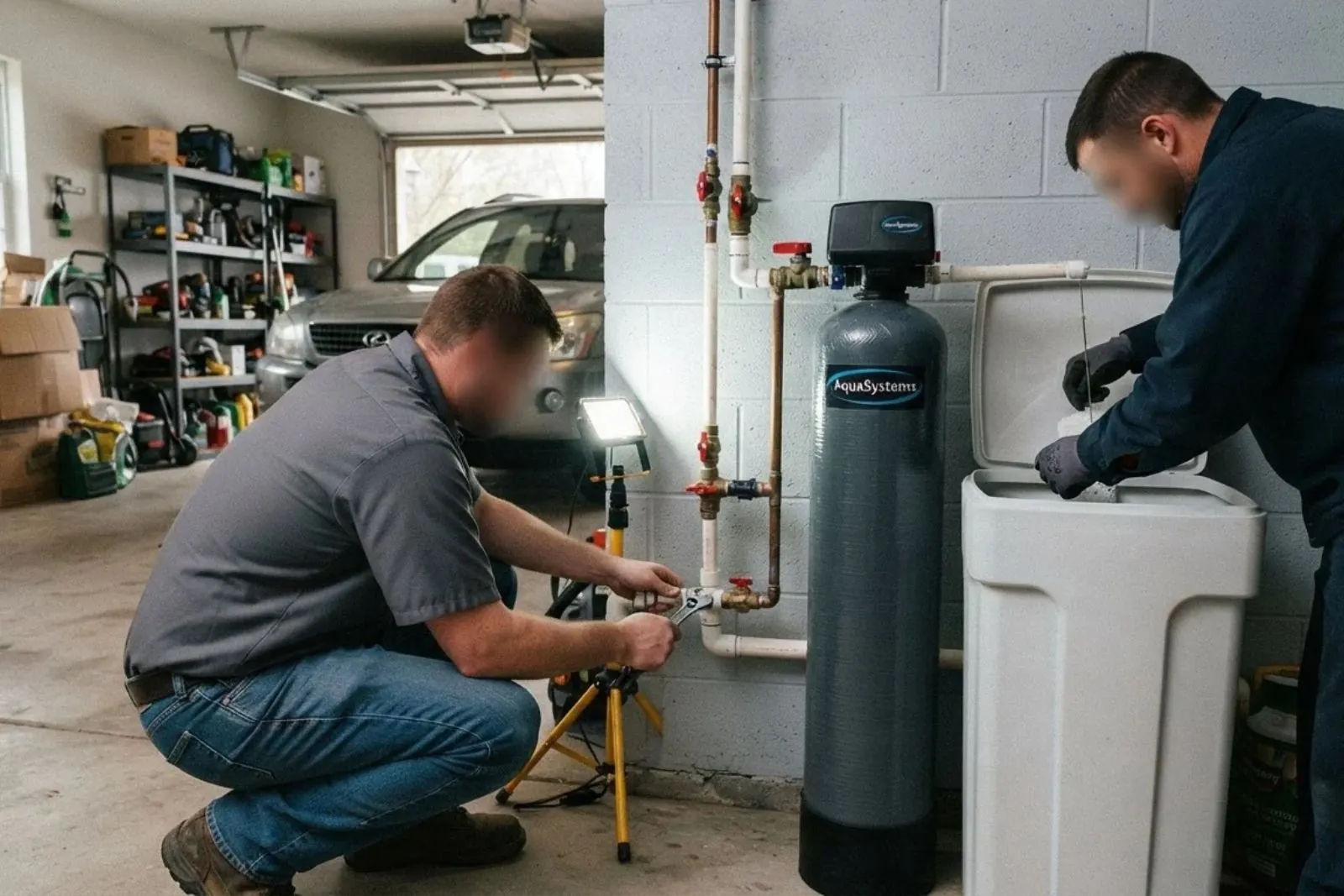
A softener sized to your water, not someone else's
A water softener is a tank of resin beads that swaps the calcium and magnesium in your water for sodium or potassium through ion exchange. The result is water that leaves less scale in pipes, water heaters, and fixtures.
In Surprise, the right softener depends on which utility serves your address. EPCOR's Agua Fria district blends Colorado River water from the Central Arizona Project with Agua Fria River water and groundwater from 15 wells. The city's own Mountain Vista system relies only on groundwater, drawn from 16 wells.
Published hardness numbers for Surprise do not agree, and some differ by more than three times. That is why every install starts with a test at your tap. The reading sets the softener size and its regeneration setting.
The West Valley of Maricopa County leans heavily on groundwater, which is part of why readings from older neighborhoods near Surprise Stadium can differ from newer builds north of Loop 303. A tap test settles it for your own address. Some homes from the 2000s, Arizona Traditions among them, were built with that loop in place, which shortens an install considerably.
What your hardness reading means
Your test result falls into one of these bands. The band tells you whether a softener is worth it.
| Reading | Water Quality Association band | What it means at home |
|---|---|---|
| 0 to 3.5 gpg | Soft | A softener is rarely needed. Filtration may still help with taste. |
| 3.5 to 7 gpg | Moderately hard | Some spotting on glass and slow scale in the water heater. A softener is optional. |
| 7 to 10.5 gpg | Hard | Visible scale on aerators and showerheads. A softener protects heaters and fixtures. |
| Over 10.5 gpg | Very hard | Fast scale buildup, short tankless heater service intervals. A softener is strongly worth considering. |
To convert a ppm reading from a water report, divide by 17.1 to get grains per gallon.
What a proper softener install includes
A softener that is installed badly can cause problems a good unit never would. These are the pieces to expect.
- A bypass valve. It lets you send water around the softener for service or for outdoor use without shutting off the house.
- An air-gapped drain. The brine discharge must empty through an air gap into the drain so waste water cannot be siphoned back into the supply.
- The right loop connection. Many Surprise homes were built with a softener loop in the garage. Using it keeps outdoor hose bibs on unsoftened water.
- A nearby outlet. Most control valves need a standard outlet. An extension cord across the garage floor is not a permanent answer.
- Correct settings. Hardness, household size, and regeneration time are programmed from your test, not left at factory defaults.
Softener not working? Common problems and fixes
Repairs are often simpler than a new unit.
| Symptom | Likely cause | Usual repair |
|---|---|---|
| Spots and scale are back. | Out of salt, or a salt bridge crusted over the brine. | Break up the bridge and reset the regeneration. |
| Brine tank full of water. | Blocked brine line or a stuck float. | Clear the line or replace the float assembly. |
| Unit never regenerates | Failed timer, motor, or control board. | Repair or replace the control valve head. |
| Low pressure through the softener. | Resin fouled or crushed after years of use. | Replace the resin bed |
| Salty taste at the tap. | Regeneration or rinse setting is off. | Reprogram the cycle and check the injector. |
Salt-based softener or salt-free conditioner?
Salt-free systems do not remove hardness minerals. They change how the minerals behave so less scale sticks to surfaces. You will still see spots on glass, and a hardness test will read the same afterward.
An ion exchange softener removes the minerals. If your reading lands in the hard or very hard band, and you care about the water heater and a tankless unit most of all, that is the system that actually changes the number.
What sets the price of a softener install or repair
Install estimates cost nothing. Repair visits come with a quote after the unit has been checked.
| Cost factor | How it moves the price |
|---|---|
| Hardness and household size | Harder water and more people call for a larger resin tank. |
| Existing loop | A pre-plumbed garage loop makes installation faster than running new pipe. |
| Drain and power | Adding an air-gapped drain or an outlet adds time if neither is nearby. |
| Salt or potassium | Potassium chloride costs more per bag than sodium chloride over the life of the unit. |
| Repair or replace | A new control head or resin can extend an older unit. A cracked tank usually means replacement. |
Insurance and water treatment equipment
Insurance does not cover a softener purchase. If a softener or its drain line leaks and damages the floor, that sudden damage may be covered, but the unit itself generally is not.
Ready for a quote? Call (623) 301-9042 to set up the free hardness test and estimate.
Surprise water hardness by system, and what it means for a softener
The City of Surprise runs four water systems, and each publishes its own report. The 2025 reports list total hardness of about 3.9 grains per gallon for Mountain Vista, 6.2 for Desert Oasis and 5.3 for Surprise Foothills. The Circle City report lists 8.2, and its year column is mixed, so use that figure with care.
EPCOR reports for Sun City West and Sun City show wider ranges of 4 to 12 and 7 to 11 grains per gallon. Ask your supplier which report applies to your address.
Callers also ask about repairs. A softener whose regeneration line was cut during construction, a broken valve after a move or a control head that no longer cycles can often be repaired. Bring the make and model.
Water softener questions for Surprise
It depends on your reading. Hardness varies by supplier and source, so a test at your tap is the only way to know. Readings in the hard or very hard band make a softener worthwhile.
Your supplier's annual water quality report lists a hardness figure, and a tap test during the install estimate confirms it for your address. Divide a ppm figure by 17.1 to convert it to grains per gallon.
Yes. Softener install estimates, including the hardness test, are free. Repair visits are priced on site before any work begins.
Check the brine tank monthly and keep it about half full. Usage depends on hardness and household size, so harder water and bigger families go through salt faster.
It usually should not. Softened water is not ideal for landscaping, which is why most garage loops leave outdoor spigots on hard water.
If the tank is sound, a new control head or resin can buy several more years. If the tank is cracked or parts are no longer made for the valve, replacement makes more sense.
It depends on the water system. The City's 2025 reports list roughly 4 to 8 grains per gallon on average across its systems, and EPCOR's Sun City West report lists 4 to 12. Check the report for your address.
Yes. We install customer-supplied softeners and size the bypass, drain and hard water connections.
Softeners work best alongside these services
A softener handles minerals but not taste or chlorine, which is where whole-home water filtration comes in. Soft water also stretches the time between descaling visits for a tankless water heater, a unit hard water wears down fastest.
The same testing-first approach applies next door, where El Mirage water softener customers may be on a different supplier than their Surprise neighbors a mile away.